
TL;DR: Don’t compare your position value to what you deposited — compare it to what you would have had if you’d just held the tokens. If fees earned exceed divergence loss, LP is working. If your fees are flat, the first thing to check is whether your position is out of range.
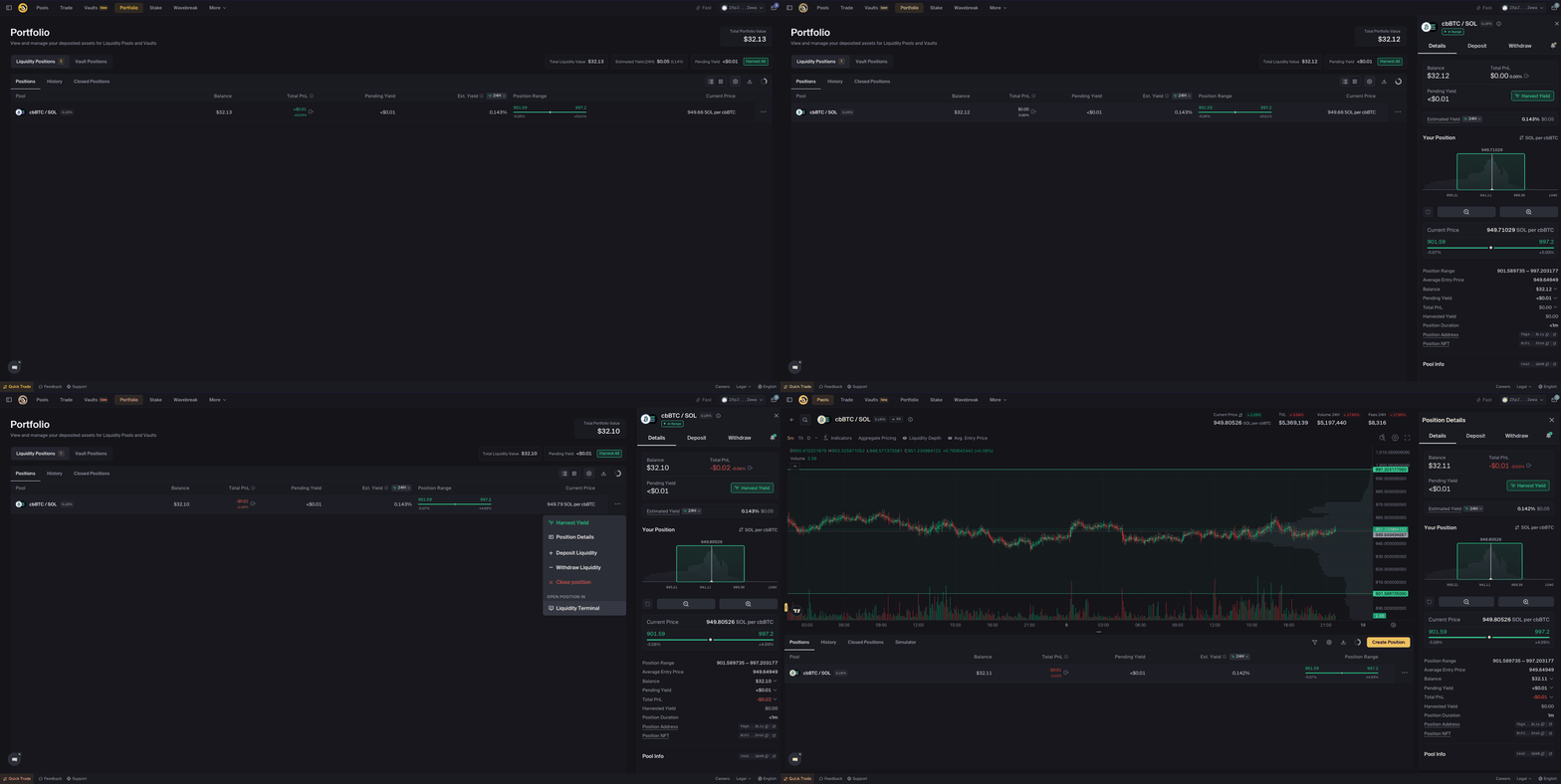
The metrics explained
Current value
The current market value of your LP position — what you’d receive (approximately) if you withdrew right now, based on current token prices and pool composition. This number changes for two reasons: token prices move, and your position’s composition shifts as the pool rebalances. Both can cause the current value to rise or fall even if you haven’t done anything.Fees earned
The total fees your position has collected since it was opened. This is cumulative — it includes fees you’ve already harvested and fees still sitting in the position waiting to be collected. Fees earned only accumulates when your position is in range. When the price is outside your range, fee accrual stops.Price range status
Whether the current price is inside or outside your selected range.- In range — your position is active and earning fees from trades.
- Out of range — your position is inactive. You’re not earning fees, and your position has been converted entirely into one token.
The comparison that matters
The most useful question isn’t “is my position worth more than I put in?” It’s: is my position worth more than it would be if I’d just held the tokens? If you deposited 1 SOL and 100 USDC when SOL was $100 ($200 total), and SOL is now $150:- Just holding would give you $250 (1 SOL × $150 + 100 USDC)
- Your LP position will be worth somewhat less than $250, because the pool rebalanced toward USDC as SOL rose
Why your position composition changes
As the price moves within your range, the pool automatically adjusts the ratio of the two tokens in your position. This is how concentrated liquidity mechanics work — it’s not a bug or a loss, it’s the expected behavior. At the lower bound of your range, your position is 100% in the base token. At the upper bound, it’s 100% in the quote token. Somewhere in the middle, it’s a mix. This means that if you open a SOL/USDC position and SOL rises significantly, you’ll end up holding more USDC and less SOL than when you started. If you wanted to maintain a specific token ratio, you’d need to close and reopen the position.What does out of range mean for my position?
When your position goes out of range, a few things happen:- Fees stop accruing. You’re no longer providing active liquidity, so you earn nothing from trades.
- Composition locks in. The position becomes 100% one token and doesn’t rebalance further.
- Divergence loss is realized at the range boundary. The position moved to 100% of one token at the price where your range ended — not at the current price.
Fees earned vs. total return
Fees earned is a cumulative number — it always goes up, never down. But it tells you only half the story. Your total return relative to holding = fees earned − divergence loss. Divergence loss isn’t shown as a standalone number in the dashboard — it’s implicit in the gap between your current position value and what a simple hold would be worth. To get a clear picture of your total return, you’d need to compare your current position value plus fees earned against the value of holding the original deposit. The position history page shows your position’s performance over time, which makes this comparison easier to track across multiple periods.Practical signals to watch
View and manage your positions directly at orca.so/portfolio.
Related
Understanding your LP returns
How fee income and divergence loss interact to determine your actual return.
Position history
Track performance across your positions over time.
Harvest yield
How to collect accumulated fees from your position.
LP simulator
Model fee income and divergence loss before opening a position.