
Quick check: LPing may be more suitable for users who are comfortable holding both assets in a pair, understand that returns are not guaranteed and depend on trading volume and price behavior, and are willing to actively monitor their positions. If you’re expecting a strong one-directional price move, simply holding will likely outperform LP.
What you’re actually doing
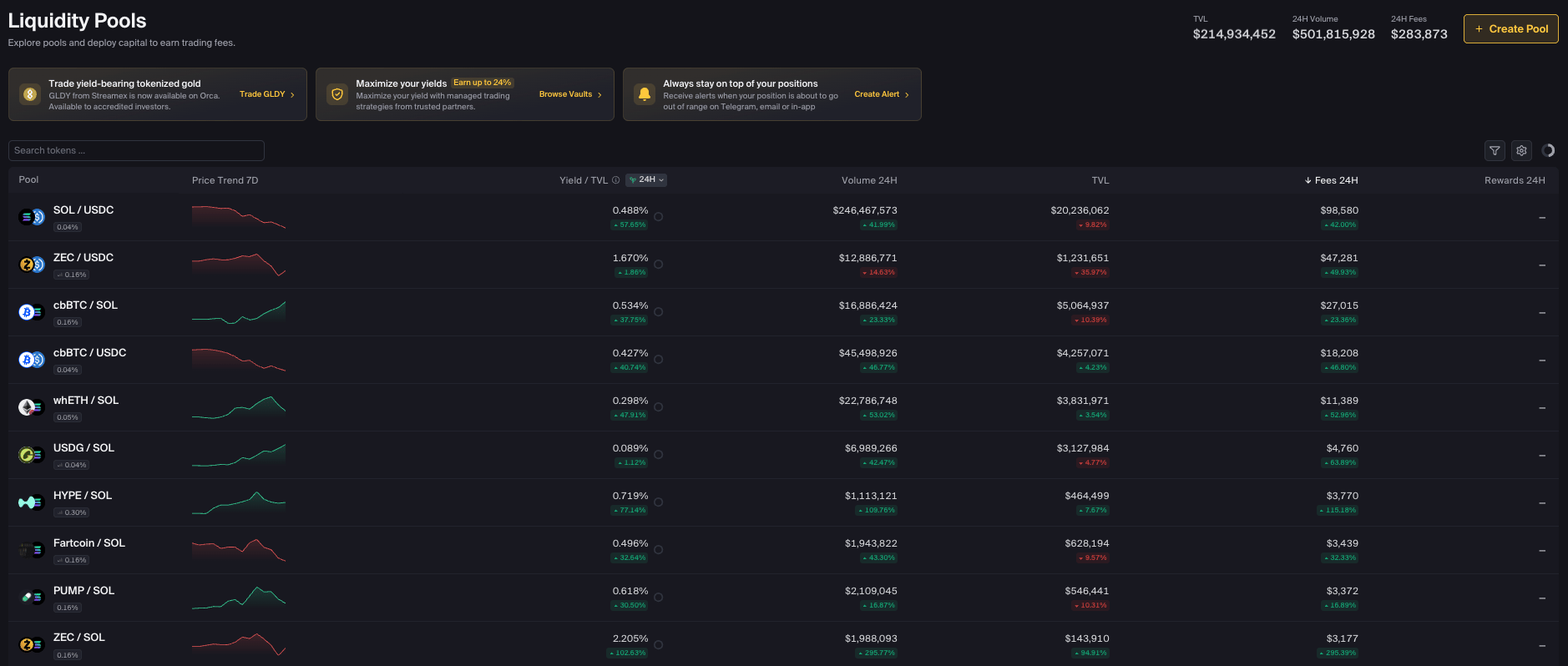
When you provide liquidity on Orca, you’re depositing two tokens into a pool. Traders swap through your pool and pay a fee on every trade. You earn a share of those fees proportional to your share of the pool’s liquidity. In exchange, your position changes composition over time. As the price moves, the pool automatically rebalances between the two tokens. If you put in SOL and USDC, and SOL goes up, you’ll end up holding less SOL and more USDC than when you started. If SOL goes down, the opposite happens. This automatic rebalancing is what creates divergence loss — the gap between what your position is worth and what it would have been worth if you’d just held the tokens. Fee income offsets this loss. Whether you come out ahead depends on how much trading activity flows through your pool relative to how much the price moves.Three ways allocators approach this
Most LPs come to liquidity provision from one of three starting points: Asset-first — you already hold an asset and want to put it to work. You’re not changing your exposure; you’re earning yield on top of it. The question becomes which pool and range gives you the best fee income without unacceptable divergence loss risk. Yield-first — you have capital and want to earn a target return. You’re evaluating LP as one option alongside lending, staking, or other yield sources. The question becomes whether the available APRs justify the added complexity and risk. Opportunity-first — you see a narrative, event, or market condition you want to play. A new token launch, a correlated pair with predictable range behavior, a high-volume period. The question becomes how to structure a position that captures the opportunity without overexposing yourself. None of these is the wrong approach, but they lead to different pool choices, range strategies, and acceptable risk profiles.When does LP tend to work well?
High-volume, stable pairs — pools like SOL/USDC or major stablecoin pairs generate consistent fee income because there’s always trading activity. The risk of divergence loss is real but manageable if you choose a reasonable range. Correlated assets — pairs that tend to move together (e.g., two stablecoins, two liquid staking tokens) have lower divergence loss risk because the price ratio stays relatively stable. Fee income accumulates without the position drifting far from your initial composition. Periods of high volatility — counterintuitively, high volatility often means high trading volume, which means higher fee income. If you have a tight range and the price stays within it during a volatile period, you can earn outsized fees. The risk is that the price moves outside your range. Ranges you actively manage — concentrated liquidity rewards active management. LPs who monitor positions, rebalance when price moves out of range, and harvest fees regularly tend to outperform passive holders of the same position.Past APR figures reflect recent fee income and are not a guarantee of future returns. Volume and fee rates can change significantly over short periods.
When does LP tend not to work well?
Strong directional price movement — if you believe an asset is going significantly up or down, just holding it (or not holding it) will almost always outperform LP. Divergence loss compounds in one-directional markets. LP works best when the price oscillates within a range, not when it trends. Low-volume pools — fee income depends entirely on trading volume. A pool with low volume generates little income regardless of how tight your range is. Before entering a pool, check its 24h and 7d volume. Capital you need liquid quickly — LP positions can be withdrawn at any time, but withdrawing while the price is out of range means withdrawing a position that’s heavily weighted toward one token. If you need to exit at short notice, you may be selling at an unfavorable composition. Assets you don’t want exposure to — you’re always holding two assets in an LP position. If you’re only comfortable holding one of them, LP in that pair isn’t the right structure.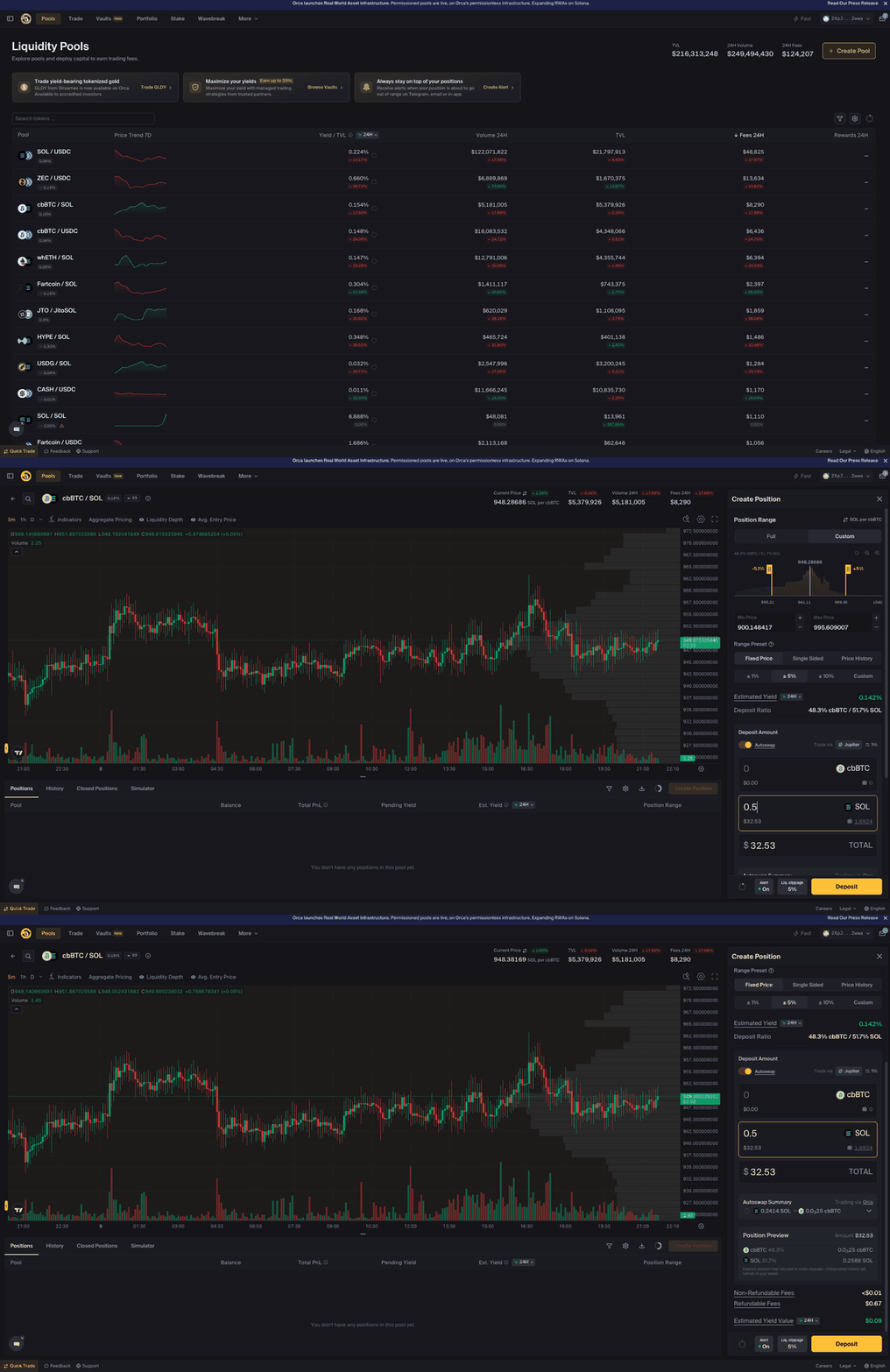
Questions worth answering before you enter
Before committing capital, it’s worth working through these:- What’s the pool’s 7-day volume? Low volume means low fees regardless of APR estimates.
- What range am I choosing, and how often has the price been in that range recently? Out-of-range positions earn nothing and accumulate divergence loss.
- How much divergence loss am I willing to absorb? Use the LP simulator to model this before you enter.
- Am I comfortable holding both tokens at any ratio? At the extremes of your range, you may end up holding almost entirely one token.
- How often will I check and rebalance? A position you never check is a position that may sit out of range earning nothing.
Browse pools on Orca
Explore available pools, filter by volume and fee tier, and find a pair that fits your strategy.
Next steps
Beginner's guide
Step-by-step walkthrough of opening your first position.
LP simulator
Model fee income and divergence loss for a given range before committing capital.
Understanding divergence loss
A deeper look at how divergence loss works and how to think about it.
Advanced strategies
Range selection, position sizing, and active management approaches.